
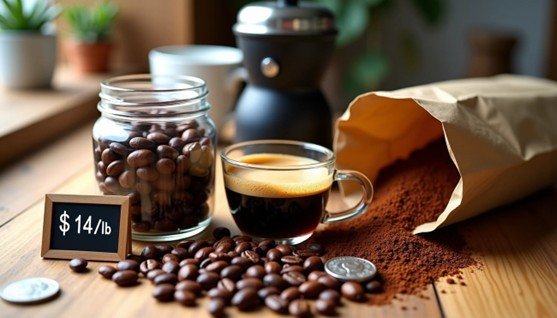
When it comes to coffee beans vs ground, for years I didn’t even care about the difference. I was just your typical “average Joe” who relied on pre-ground coffee for convenience. I always thought the relatively lower price of factory pre-ground coffee justified my habit of ignoring whole coffee beans. Like many others, my mornings followed the exact same routine: grab a bag of factory pre-ground java, scoop it in, hit brew, and move on. It was quick, predictable, and honestly, it worked perfectly with my busy schedule.
But after a while, I realized that sticking with convenience made things feel stale, and my taste buds started to notice.
My change didn’t begin with any fancy equipment at home. It actually started in the grocery store. Out of curiosity, I skipped my usual pre-ground coffee, picked up a bag of whole beans, and used the big grinder at the store. As soon as the machine started, the strong, fresh smell filled the aisle and caught my attention. When I brought that coffee home and compared them to my regular pre-ground coffee, the difference was eye-opening.
The flavor was stronger, richer, and simply tasted much fresher.
This change isn’t magic; it is the direct result of avoiding rapid oxidation. As soon as a coffee bean is ground, its trapped oils and aromatic gases begin to escape. Grinding at the store still exposes coffee to air, but it remains far fresher than a pre-ground bag that may have sat on a shelf for months. That revelation made me give up my old routine and changed how I looked at the math behind my morning cup.
While pre-ground coffee wins the price battle at the register, it isn’t always the better deal. Stale grounds that get dumped or double-scooped can eat into the savings. Here’s the math, and when whole beans actually come out ahead.
Upfront Price: Are Coffee Beans Cheaper Than Ground Coffee?
What You Pay Per Pound in 2026
According to data tracking from the U.S. Bureau of Labor Statistics (BLS), standard ground coffee averages around $9.33 per pound in September 2026 (ranging between $6.00 and $12.00 per pound for commodity brands).
By comparison, standard whole bean coffee ranges from $10.00 to $18.00 per pound.
Why Whole Beans Cost More at Checkout
Producers reserve their highest-quality beans for whole bean packaging because visual defects cannot be hidden as easily as they can in pre-ground blends. Sourcing premium-grade beans, hand-selection, and small-batch processing add labor costs reflected at checkout.
Additionally, pre-ground coffee benefits enormously from industrial economies of scale. Automated facilities often blend lower-cost Robusta beans or standard Arabica varieties to keep shelf prices low.
Pre-Ground Coffee Pricing Breakdown
Large commercial roasters achieve low per-pound costs through massive automated processing. By blending standard Arabica with lower-cost Robusta varieties, commercial brands can maintain lower price points. Grinding also allows producers to utilize beans with minor visual defects that would otherwise be rejected for whole bean packaging.
Regional Price Variations
Import tariffs, shipping logistics, and climate-driven yield fluctuations directly impact shelf prices across origins. Higher freight rates to coastal markets and reduced harvests from major export regions continue to push retail costs upward across both whole bean and pre-ground categories.
Cost Per Cup: The Real Money Picture
Calculating Your Actual Brewing Cost
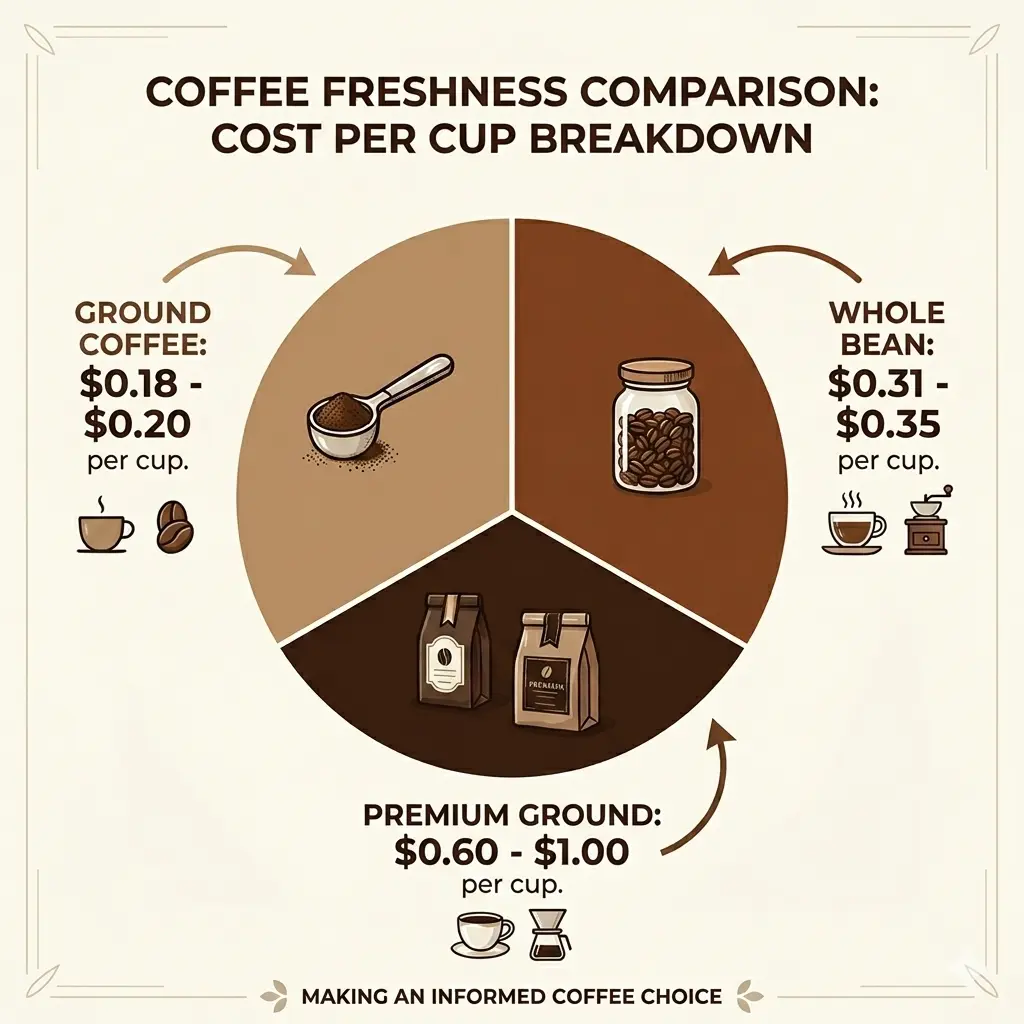
Bag prices tell only part of the story. At $8.00 per pound, ground coffee yields about 40-45 cups (roughly 10 grams per cup), which works out to $0.18-$0.20 per cup. Whole bean coffee at $14.00 per pound yields the same number of cups, or $0.31-$0.35 per cup.
With whole beans, you control the grind size and brew strength, which can improve the quality of each cup. That’s a real benefit, but it doesn’t change the price-per-cup numbers above.
The usable cup efficiency factor: On paper, pre-ground coffee appears cheaper per cup based on sticker price alone. However, this raw calculation assumes every ounce is consumed at peak quality. In reality, ground coffee noticeably loses flavor within about a week of opening, leading to discarded stale grounds or double-scooping. In the coffee beans vs ground debate, freshness matters: whole beans stay fresher for 2 to 4 weeks after opening, which can shrink the cost gap once you account for real-world waste, though at the example prices it doesn’t close it.
How Grind Control Affects Coffee Usage
Grind size affects how well your coffee extracts. Grounds that are too fine over-extract and taste bitter or burned, while grounds that are too coarse under-extract and taste weak and flavorless. Moccamaster notes that most supermarket pre-ground coffee is ground too finely for its brewers, so it’s worth checking that the grind in the bag suits your machine. With whole beans, you can adjust the grind to fit your brewer.
Waste Factors That Affect Your Wallet
One UK roaster estimates that cafés lose around 10% of their coffee to waste, including stale coffee, grinder purging and dialing in. That’s a commercial estimate, not a figure for home brewers. This post assumes a home scenario: about 5% waste for whole bean, and 15-25% for pre-ground that goes stale before you finish it. These are estimates, not measured figures.
Freshly Ground Coffee vs Pre Ground Coffee: Why Freshness Matters
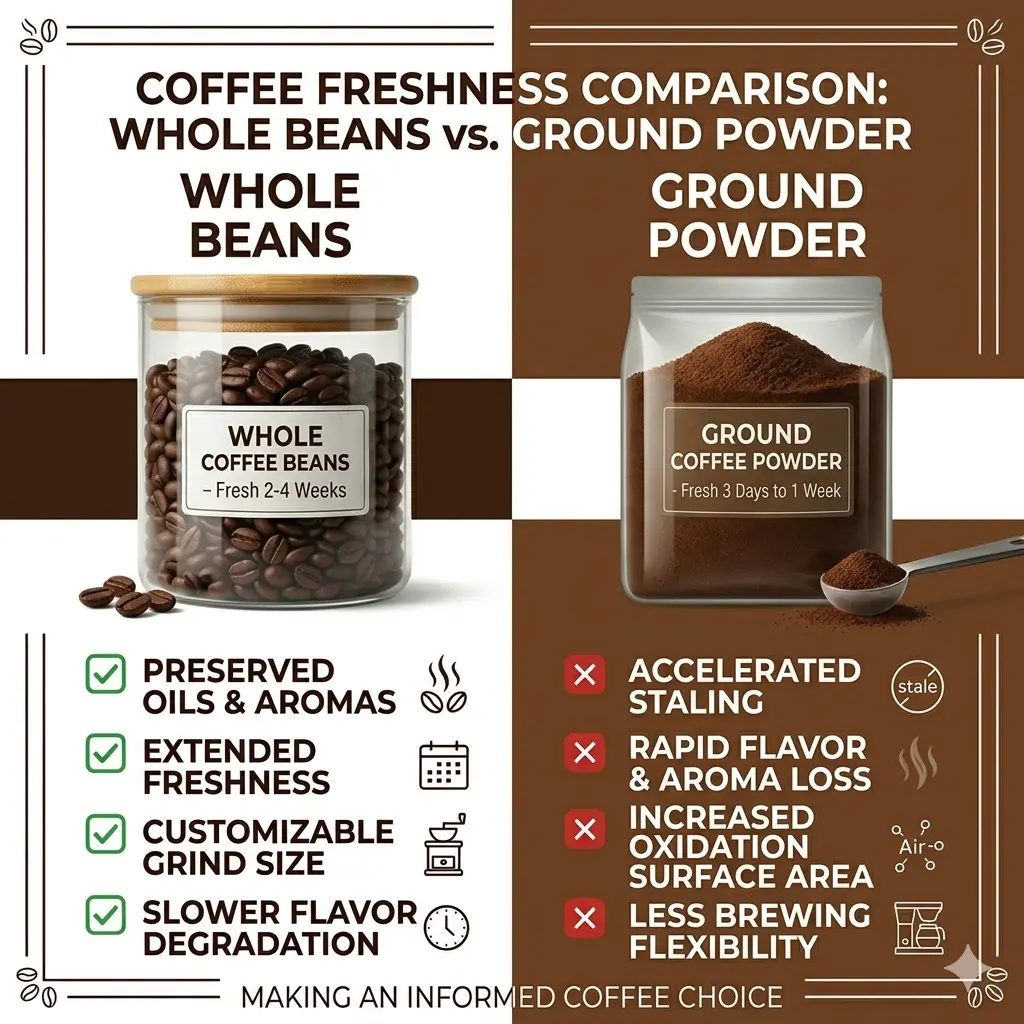
Rapid oxidation causes pre-ground coffee to lose its delicate aromatic oils almost immediately after opening, often leading to stale or flat-tasting cups that get dumped down the sink. Switching to whole beans eliminates this hidden waste factor, protecting your monthly budget by ensuring you drink every ounce you buy.
Hidden Costs and Long-Term Savings
Coffee Grinder Investment Requirements
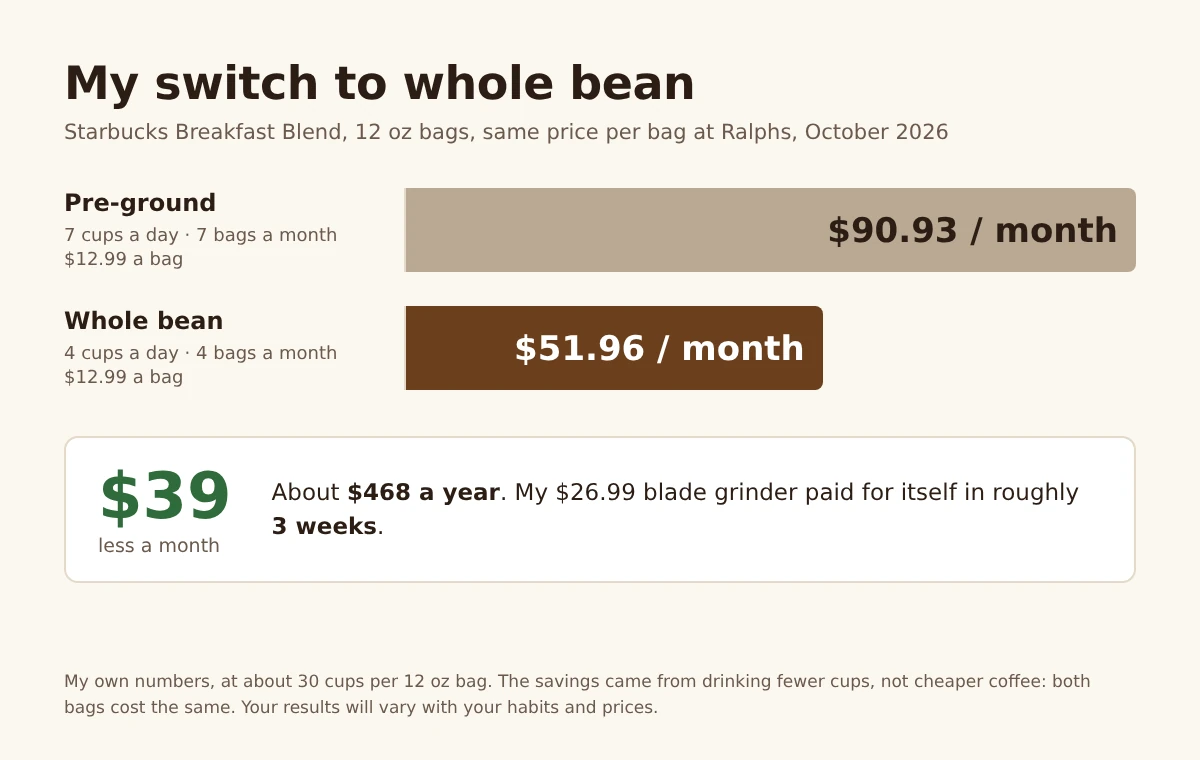
In my own case, whole bean and pre-ground cost the same per bag ($12.99 for 12 oz). My savings came from drinking fewer cups, about 4 a day instead of 7, not from cheaper coffee. That matches the point above: whole bean wins on cost when the prices are close, and my $26.99 grinder paid for itself in about three weeks.
Basic electric blade grinders cost around $25. For example, the SHARDOR 70g grinder, which has a timing knob to help you repeat the same grind, was listed on Amazon at $26.99 in October 2026. Reviewers generally prefer burr grinders for a more even grind: CoffeeGeek puts a good grinder at about $200, hand burr grinders start around $69 in Chowhound’s tests though Amazon lists electric burr grinders from about $30, and CoffeeGeek lists the electric Baratza Encore at $149. For everyday brewing, though, even an inexpensive grinder is enough to get the freshness benefits of whole beans.
Shelf Life: Whole Bean vs Ground Coffee Freshness Over Time
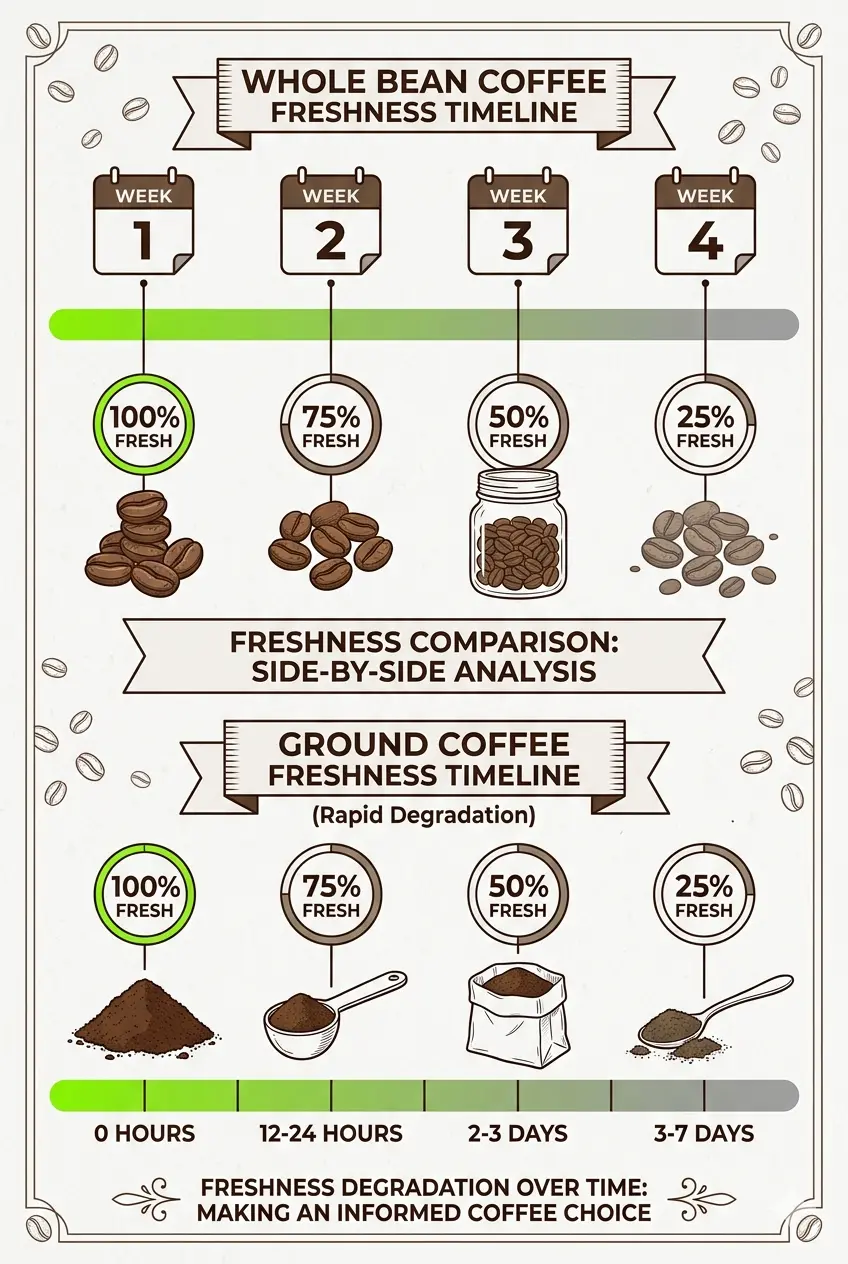
Unopened whole beans last 6-9 months, while unopened ground coffee lasts 3-5 months. Once roasted, whole beans are at their best for about 2-4 weeks when stored properly. Ground coffee loses aroma within 24 hours, loses sweetness within about a week, and tastes stale by 2-3 weeks.
How Faster Spoilage Drains Your Budget
Grinding increases coffee’s surface area by more than ten thousand percent, which speeds up oxidation. According to Headcount Coffee, reduced aroma is already noticeable within 24 hours of grinding, and sweetness fades within about a week. That’s why pre-ground coffee can go stale before you finish the bag.
Storage Solutions That Protect Your Investment
Keeping coffee away from air, light, heat and moisture helps slow staling, but a canister isn’t automatically better than the bag it came in. In a 2022 study of opened whole beans, the original bag with an integrated screw cap kept aroma best, while moving the beans to an airtight metal canister led to the fastest loss of freshness. Vacuum canisters are designed to remove the air: Fellow claims its Atmos vacuum canister can extend coffee’s shelf life by roughly 50 percent, and The Spruce Eats’ testers found it keeps coffee fresh longer than other options. Canisters range from about $25 to $80, and most cost between $30 and $40, according to Food & Wine’s testing.
Which Option Saves You More Money?
Whole Bean vs Ground Coffee Cost for Daily Drinkers
At $8 a pound for ground and $14 for whole bean, with two cups a day (about 16 pounds a year), ground coffee costs roughly $130 a year and whole bean about $227. Add an $80 burr grinder and year one is about $307. Whole bean doesn’t win on price at these numbers. For it to break even, pre-ground coffee would have to lose nearly half of every bag to staleness.
When Whole Bean Does Save Money
Whole bean can come out ahead when you compare the same coffee at the same price per pound, which many roasters offer for both whole bean and ground. Say pre-ground coffee goes stale before you finish it, so you waste or over-dose about 15-25% of it, while whole bean loses only about 5%. At $8-$10 a pound, that works out to roughly $16-$46 a year in savings. A $25 blade grinder would pay for itself in 1-2 years, and an $80 burr grinder in 2-5 years. These waste rates are estimates for illustration, so adjust them for your own habits.
Occasional Drinker Budget Analysis
Brewing 2-3 times weekly changes the math. Grinder investment takes longer to recoup when consumption stays low. Pre ground coffee makes financial sense if you finish bags before spoilage occurs.
Break-Even Timeline for Equipment Investment
Whether a grinder pays for itself depends on how much coffee you drink and how much stale coffee you’d otherwise waste. At two cups a day, using the waste scenario above, a $25 blade grinder pays for itself in roughly 1-2 years, and an $80 burr grinder in roughly 2-5 years. If you only brew a few times a week, expect it to take several times longer. And if the whole bean you buy costs more per pound than the ground version, a grinder may never pay for itself in dollars alone.
Lifestyle and Convenience Trade-Offs
Whole bean coffee takes an extra 15 seconds or so to grind, plus the occasional grinder cleaning, but rewards you with fresher flavor. Pre-ground coffee trades some of that freshness for convenience, and at typical prices it costs less per cup.
Whole Bean vs Ground Coffee Cost Comparison Table (2026)
| Attribute | Whole Bean Coffee | Pre-Ground Coffee |
|---|---|---|
| Price Per Pound | $10-$18 (standard) | $6–$12 (standard) $9.33 average (Sep 2026) |
| Cost Per Cup | $0.31-$0.35 (at about $14/lb) | $0.18-$0.20 (at about $8/lb) |
| Shelf Life (Unopened) | 6–9 months | 3–5 months |
| Peak Freshness | About 2-4 weeks after roasting | Within days (aroma fades in 24 hours, tastes stale by 2-3 weeks) |
| Equipment Required | Coffee grinder ($20-$150+ initial investment) | None (simple brewing equipment only) |
| Annual Cost (Daily Drinker, 2 cups/day) | Year 1: $307 (with $80 grinder) Year 2+: $227 | $130 |
| Grinder Value | Can pay for itself in roughly 1-5 years if you’d otherwise waste stale grounds (see estimate above). | N/A |
| Waste Factor | About 5% (estimate) | 15-25% if it goes stale (estimate) |
| Quality Control | Easier to judge bean quality before you buy | Harder to judge bean quality once ground |
| Grind Control | Full control over grind size | Fixed grind size, which may not suit your brewer |
| Best For | Daily drinkers who value freshness and flavor, especially when whole bean is priced close to ground. | Occasional drinkers who prioritize convenience and lower upfront costs |
Conclusion
Do whole coffee beans save money? On price alone, usually no. At $8 a pound for ground and $14 for whole bean, whole bean costs roughly $97 more a year before you buy a grinder. It can come out ahead when the two cost about the same per pound and you’d otherwise waste stale pre-ground coffee, and it delivers fresher flavor either way.
Whole beans are worth it when freshness matters to you and the price per pound is close to ground. If you’re still undecided, calculate your annual consumption and break-even timeline. Your wallet will thank you for choosing the option that matches your brewing frequency.
Key Takeaways
Understanding the true cost of your coffee habit requires looking beyond sticker prices to consider freshness, waste, and long-term value.
- On price alone, pre-ground coffee costs less: about $130 a year vs. about $227 for whole bean at $8 and $14 a pound, drinking two cups a day.
- Whole bean can come out ahead when it’s priced close to ground and you’d otherwise waste stale pre-ground coffee.
- Ground coffee goes stale faster: aroma fades within 24 hours, and it tastes stale by about 2-3 weeks.
- A grinder costs roughly $20-$150 or more upfront, and can take about 1-5 years to pay for itself if you’d otherwise waste stale grounds.
- Pre-ground coffee can make sense for occasional drinkers who prioritize convenience and lower upfront costs.
- With whole beans, you can adjust the grind to fit your brewer.
Whole beans don’t necessarily cost less, but they can provide better value when freshness, grind control, and brewing quality are considered. Pre-ground coffee remains a practical choice for people who prioritize convenience and don’t want to invest in a grinder.
FAQs
Q1. How long does coffee stay fresh?
Whole bean coffee is at its best for about 2-4 weeks after roasting when stored properly, while ground coffee loses aroma within 24 hours and tastes stale by about 2-3 weeks. This difference means ground coffee can go to waste before you finish the bag, which raises your effective cost per cup.
Q2. Is pre-ground coffee really cheaper than whole beans?
Usually, yes. Pre-ground coffee typically costs $6-$12 per pound compared to $10-$18 for whole beans. At $8 and $14 a pound, whole bean costs about $97 more a year before you buy a grinder. Ground coffee does lose freshness faster, which can lead to more waste, so the gap closes only when the two are priced similarly per pound.
Q3. Do I need an expensive grinder to make whole beans worthwhile?
Not necessarily. On Amazon in October 2026, basic blade grinders started around $20 and electric burr grinders around $30, and even an inexpensive one lets you grind beans fresh. Reviewers generally recommend spending more for a burr grinder that lasts.
Q4. Does grind size really matter?
Yes. Grounds that are too fine over-extract and taste bitter, while grounds that are too coarse under-extract and taste weak and flavorless. Pre-ground coffee comes in a fixed grind that may not suit your brewer, while whole beans let you adjust the grind to fit it.
Q5. Which option saves more money for occasional coffee drinkers?
Pre-ground coffee makes better financial sense for occasional drinkers who brew only 2-3 times weekly. The grinder investment takes much longer to recoup with low consumption, and you’re more likely to finish pre-ground bags before significant spoilage occurs. Whole beans make the most financial sense for daily drinkers who can buy them at a price close to ground, or who value the fresher flavor enough to pay a little more.
Alternative: Whole Bean Coffee Subscriptions
If buying in bulk isn’t practical for you, consider a subscription service. They often deliver freshly roasted whole beans regularly, helping you maintain freshness.